Crafting Cosmetics
Sorbitan Stearate
Sorbitan Stearate
Couldn't load pickup availability
Product Overview
Sorbitan Stearate is a PEG-free, non-ionic lipophilic emulsifier belonging to the sorbitan ester family, produced through the esterification of sorbitol with stearic acid. With a low HLB value of 4.7, it serves as a primary water-in-oil (W/O) emulsifier and a versatile co-emulsifier in oil-in-water (O/W) systems, granting formulators precise control over emulsion architecture and texture. Valued for its vegetable-derived origin, mild character, and compatibility across a broad range of cosmetic formats, Sorbitan Stearate delivers stable, elegant emulsions with a smooth, conditioning skin feel.
Key Benefits & Cosmetic Applications
Sorbitan Stearate offers formulators a flexible, naturally derived emulsification tool that performs across both oil-continuous and water-continuous systems. Its non-ionic, PEG-free chemistry makes it a preferred choice for clean-beauty and sensitive-skin formulations.
- Versatile Emulsification Profile: Functions as a standalone W/O emulsifier at HLB 4.7, or pairs synergistically with higher-HLB emulsifiers to build stable O/W creams, lotions, and milks with tailored consistency.
- PEG-Free & Non-Ionic Chemistry: Eliminates the need for ethoxylated ingredients, supporting cleaner label positioning while maintaining broad electrolyte and pH tolerance typical of non-ionic surfactants.
- Oil-Phase Integration: Fully soluble and dispersible within the oil phase, simplifying processing and ensuring uniform distribution without requiring pre-dissolution steps in water.
- Texture & Sensory Enhancement: Contributes a soft, non-greasy emolliency and a smooth, velvety after-feel to finished emulsions, improving spreadability and skin comfort.
- Broad Application Range: Suitable for skin care creams, lotions, sun protection formulations, shower and bath products, and anhydrous or low-water systems.
Common Cosmetic Applications
- W/O and O/W facial and body creams
- Sun protection emulsions
- Shower gels and bath preparations
- Rich body butters and balms
- Conditioner and hair mask emulsions
Technical Profile & Specifications
| Property | Specification |
|---|---|
| INCI Name | Sorbitan Stearate |
| CAS Number | 1338-41-6 |
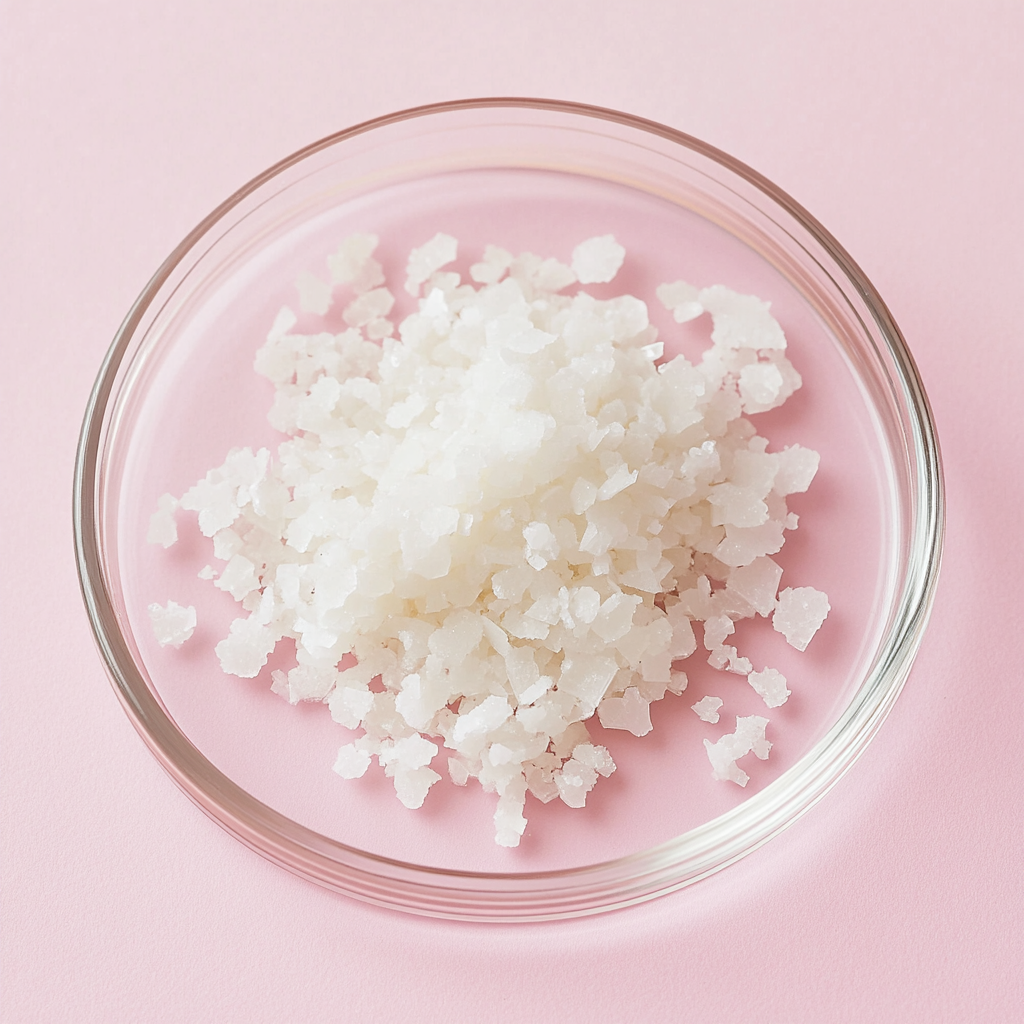
| Appearance | Off-white waxy flakes |
| Purity / Active Content | ≥ 100.0% |
| Solubility | Insoluble in water; soluble in oils, ethanol, and organic solvents |
| Functional Class / Role | Emulsifier |
| HLB Value | 4.7 |
| Suggested Usage Rate | 0.5 – 5.0 % |
| Recommended Processing Phase | Oil (lipid) phase |
| Shelf Life & Storage | 2 years. Store in a dry place in a tightly sealed container. Avoid exposure to direct sunlight, moisture, and excessive heat |
Formulation & Processing Guidelines
How to Incorporate
- Add Sorbitan Stearate to the heated oil phase of your formulation.
- Heat the oil phase to approximately 60–70 °C (or until the emulsifier is fully melted and dispersed) before combining with the aqueous phase.
- Ensure complete dissolution and homogeneity in the oil phase prior to emulsification to avoid graininess or incomplete emulsion formation.
- In W/O systems, add the aqueous phase slowly into the oil phase under moderate agitation.
- In O/W systems where Sorbitan Stearate acts as a co-emulsifier, it is typically combined with a higher-HLB primary emulsifier (e.g., Polysorbate 60, Cetearyl Olivate/Sorbitan Olivate blends) within the oil phase.
Compatibility
- Synergies: Pairs effectively with high-HLB non-ionic emulsifiers (Polysorbates, PEG-free sugar-based emulsifiers) to achieve target HLB values for stable O/W emulsions.
- Electrolyte Tolerance: As a non-ionic material, it is generally insensitive to electrolytes; however, overall emulsion stability in high-salt systems should be verified through testing.
- pH Considerations: Non-ionic esters are broadly stable, but prolonged exposure to strongly acidic or strongly alkaline conditions may promote hydrolysis over time. Formulators targeting extreme pH ranges should conduct accelerated stability testing.
- Ionic Surfactants: Compatible with anionic, cationic, and amphoteric co-surfactants in most systems, though specific interactions should be confirmed on a formula-by-formula basis.
Formulation Tips
- Calculate the required HLB of your oil phase and blend Sorbitan Stearate (HLB 4.7) with a suitable high-HLB co-emulsifier to hit the target value for O/W emulsions.
- For W/O emulsions, use Sorbitan Stearate as the primary emulsifier at the upper end of the usage range (3–5 %) to ensure adequate interfacial coverage.
- Allow sufficient mixing time during the emulsification step; high-shear homogenisation followed by gentle stirring during cooling promotes a fine, uniform droplet size.
- In anhydrous or low-water systems (balms, butter blends), a small percentage (0.5–1 %) can aid in structuring and improving the melt-and-spread behaviour.
- Conduct a minimum 4-week stability assessment (ambient, 40 °C, and freeze-thaw cycling) for any new formulation.
Suggested Applications
- W/O barrier creams and rich night creams
- O/W daily moisturisers and body lotions (as co-emulsifier)
- Sun protection emulsions (SPF creams and lotions)
- Shower creams, bath milks, and rinse-off conditioners
- Anhydrous balms, body butters, and lip care products
Sustainability & Ethical Profile
Sorbitan Stearate is derived from the esterification of sorbitol—a polyol obtained from plant-based sugars—with stearic acid sourced from vegetable fats. This fully vegetable-derived origin positions it as a naturally derived, renewable cosmetic raw material aligned with modern clean-beauty formulation standards. The ingredient is PEG-free and non-ionic, supporting formulations that avoid ethoxylated chemistry. Its biodegradability profile is consistent with that of fatty-acid-based sorbitan esters, which are broadly recognised as readily biodegradable under standard environmental conditions.
In alignment with Crafting Cosmetics' sourcing standards, this ingredient is vegan-friendly and cruelty-free.
Regulatory & Safety Disclaimer
Disclaimer: This product is supplied as a cosmetic raw material for external use only. It is intended for cosmetic and personal care formulation applications only and should not be used as a finished product.
Technical Documentation
Share